Mango Is the New Black: How One Fruit Became the Star of America's Most Stunning Dessert Plates
Somewhere between a farmers market in Los Angeles and a patisserie in Brooklyn, something quietly shifted in American dessert culture. The fondant roses and airbrushed cakes that once dominated Pinterest boards started giving way to something more honest — and honestly, more beautiful. Thin-sliced mango fanned into rosettes. Golden cubes stacked in perfect geometric grids. Ribbons of ripe Ataulfo draped over cloud-white cream like brushstrokes on a canvas.
Mango didn't just show up to the dessert party. It took over the whole table.
The Fruit That Comes Pre-Colored
Here's the thing about mango that pastry chefs have quietly known for years: nature already did the hard work. A single ripe mango can carry a full spectrum of warm tones — deep saffron at the core fading into pale gold at the edges, with occasional blushes of coral or rose near the skin. That kind of natural gradient is genuinely difficult to replicate with dyes or food coloring, and it's exactly what makes mango such a powerful visual ingredient.
Chefs working in upscale American dining rooms have started leaning into this hard. Rather than treating mango as a flavor note buried inside a mousse or hidden in a compote, they're slicing it thin, fanning it wide, and letting those color transitions do the talking. The result looks almost too pretty to eat — which, in the age of the food photo, is basically the whole point.
"When I'm plating something with mango, I'm thinking about it the same way I'd think about a watercolor wash," says one pastry chef at a farm-to-table restaurant in Nashville. "You're not adding color — you're revealing it."
Geometry Meets Tropical
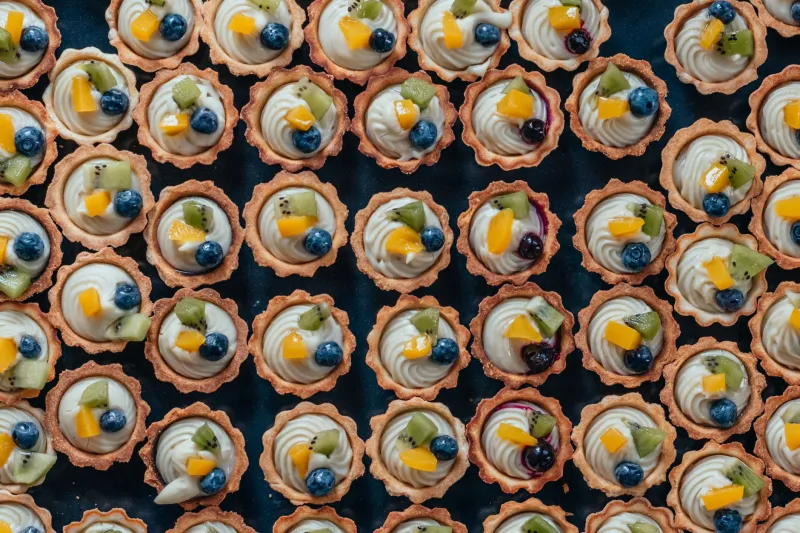
One of the most striking trends coming out of American pastry kitchens right now is the mango mandala — a plating technique where thin mango slices are arranged in concentric, symmetrical patterns on tarts, cheesecakes, or open-faced pastries. The effect is almost architectural. Think of it as the natural, tropical answer to mirror glaze: visually hypnotic, but made entirely from real ingredients.
The technique has spread fast, partly because it photographs beautifully and partly because it's more accessible than it looks. You don't need a culinary degree to fan mango slices into a spiral. You need a sharp knife, a ripe fruit, and a little patience. That combination — high visual payoff, relatively low barrier to entry — is exactly the kind of thing that travels fast on social media.
Search "mango tart" on Instagram right now and you'll find thousands of posts from home bakers across the US who've taken this idea and run with it. Some are adding edible flowers around the edges. Others are layering mango over hibiscus curd or passion fruit cream for a double tropical hit. The comments sections read like a collective gasp.
Deconstructed, Reimagined, and Unbelievably Pretty
Beyond the tart, mango has found a particularly happy home in deconstructed desserts — a format that's been popular in fine dining for a while but is now trickling down into home kitchens and casual restaurants. The deconstructed pavlova is probably the best example. Instead of building a traditional meringue dome topped with whipped cream and fruit, chefs are scattering broken meringue shards across a plate, pooling mango coulis in organic shapes, and placing fresh mango slices at intentional angles to create something that looks spontaneous but is actually very deliberate.
It's a format that rewards mango specifically because the fruit holds its shape and color even when it's sitting next to wet components. Unlike berries that bleed or citrus that can turn a plate acidic-looking, mango stays vivid and clean. It photographs warm. It photographs alive.
Why "Ingredient-Forward" Is More Than a Buzzword
The shift toward letting a single ingredient carry a dessert visually isn't just an aesthetic preference — it reflects something bigger happening in American food culture. Diners and home cooks alike are increasingly skeptical of artificial dyes and heavily processed decorations. There's a growing desire to know exactly what you're looking at on a plate, and to trust that what looks beautiful is also genuinely good.
Mango fits that moment almost perfectly. It's a fruit most Americans already know and love, but it carries enough tropical mystique to feel special. It doesn't need to be dressed up. It needs to be treated well — sliced properly, kept cold, and placed with intention.
That's a philosophy that resonates pretty deeply with what we're all about here at Sunny Days Hana Fru. Tropical flavors that bloom naturally, without shortcuts or artificial interference. When a fruit is this beautiful on its own, the best thing a baker can do is get out of the way.
The Home Baker's Secret Weapon
If you've been wanting to experiment with mango plating at home, the good news is that the learning curve is gentle. A few things to keep in mind:
Variety matters. Ataulfo (sometimes called Champagne) mangoes have a smooth, fiberless texture and a deep golden color that photographs beautifully. Tommy Atkins mangoes are larger and easier to find at most US grocery stores, but their color can be less consistent. For plating purposes, Ataulfo is worth seeking out.
Temperature is everything. Mango slices hold their shape and color best when they're cold but not straight-from-the-fridge stiff. Let them sit at room temperature for about ten minutes before you start arranging.
Contrast is your friend. Mango's warm gold tones pop hardest against white or pale backgrounds — think whipped cream, coconut yogurt, vanilla bean panna cotta, or plain meringue. A dark chocolate base can also create a stunning contrast, especially when you add a few edible flowers around the edges.
Keep it simple. The geometric tart arrangements you see on Instagram look complicated, but they're mostly just repetition. Start with a single-layer fan or rosette before attempting a full mandala. The more you practice, the more intuitive the spacing becomes.
From the Plate to the Feed
It's worth acknowledging that Instagram didn't create the mango moment — it amplified one that was already happening. American chefs were exploring tropical, ingredient-forward plating before social media made every dessert a potential viral post. But there's no question that the visual economy of platforms like Instagram has accelerated the trend and given home bakers a reason to push their own plating skills further.
What's interesting is that mango, unlike some food trends that feel purely performative, actually tastes as good as it looks. The visual drama comes with genuine flavor payoff — that sweet, floral, slightly tangy complexity that no artificial flavoring has ever quite managed to replicate.
That's the real reason mango isn't going anywhere. It earns its place on the plate twice: once for the eyes, and once for everything that comes after the photo.